

This week, AdExchanger published an op-ed by Primis CEO Rotem Shaul calling dynamic take rates "a market-wide squeeze disguised as innovation." It's worth reading, and worth taking seriously, because beneath the criticism sits a number every SSP executive should sit with.
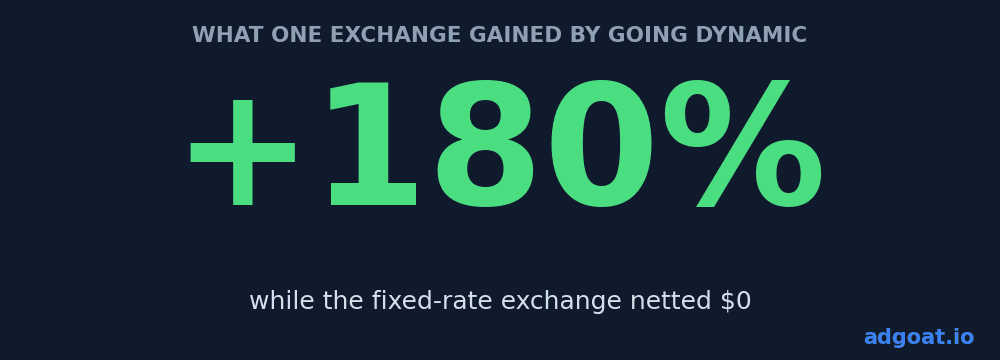
In the author's own modeled scenario, two exchanges compete at a fixed 20% take rate and split the market. Then one goes dynamic. The fixed-rate exchange's net revenue drops to zero. The dynamic one's jumps 180%. His point is that this dynamic is dangerous. Our point is simpler: it's already happening. Google has run dynamic margins for years, and Index Exchange now markets its model publicly, with The Guardian endorsing the results.
Pricing That Adapts Isn't a Distortion
On economics, we disagree. Pricing that adapts to conditions isn't a distortion of markets; it's how markets work. A hotel room costs more the night before than six months out. Airlines have priced this way for decades.
Expecting every exchange to charge an identical flat commission on every impression, forever, isn't a standard any other industry holds itself to, and it isn't one that regulation or goodwill will restore.
Transparency Is the Real Demand
On transparency, we fully agree. The article's best demand is its simplest: every exchange should be able to answer how its commission behaves, and publishers deserve that answer. The same scenario that nets the dynamic exchange +180% nets the publisher 6% less, which is exactly why how you implement dynamic margins matters.
The Real Problem: Who Has the Technology
Here's what worries us more than dynamic take rates: who has them. Today, granular, AI-driven margin optimization belongs to the players with large data science teams. If nothing changes, the prisoner's dilemma the article describes resolves the worst possible way. Independent SSPs lose share to giants not because their inventory or relationships are worse, but because their pricing technology is.
That's the gap AdGoat exists to close. We build dynamic margin optimization for independent SSPs, so the playing field levels up instead of tilting further.
The squeeze isn't the technology. It's being the last one without it.